Practical AI for Small Law Firms
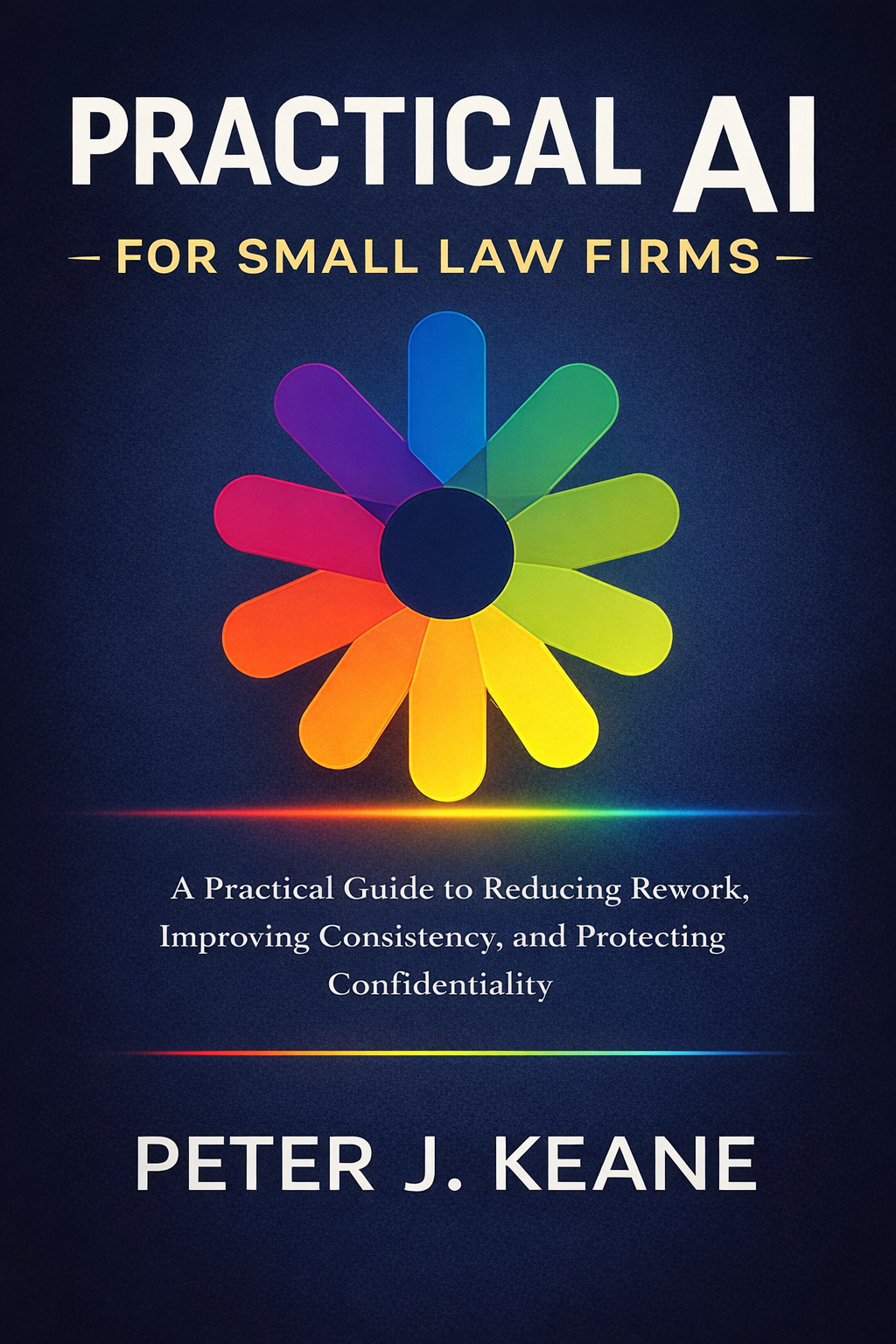
Excerpted from upcoming book Practical AI for Small Law Firms. To be released on Amazon in paperback and as a Kindle eBook.
The book was authored by Peter J. Keane a recognized technology leader for over thirty years. It is set for release on January 5, 2026.
Small law firms run on professional judgment, responsiveness, and trust. You are expected to deliver high-quality work under deadlines, with limited capacity, and often with uneven information flow. Most firms aren’t short on effort. They’re short on slack: time slack, staffing slack, and process slack.
That shortage shows up in familiar ways:
the partner who becomes the “last-mile bottleneck,”
the inbox that behaves like a triage unit,
the client who asks for “just a quick update” because they do not feel informed,
the staff member who is interrupted repeatedly because nobody knows where the latest version lives,
the matter that drifts because one missing fact stalls everything.
Small law firms run on professional judgment, responsiveness, and trust. You are expected to deliver high-quality work under deadlines, with limited capacity, and often with uneven information flow. Most firms aren’t short on effort. They’re short on slack: time slack, staffing slack, and process slack.
That shortage shows up in familiar ways:
the partner who becomes the “last-mile bottleneck,”
the inbox that behaves like a triage unit,
the client who asks for “just a quick update” because they do not feel informed,
the staff member who is interrupted repeatedly because nobody knows where the latest version lives,
the matter that drifts because one missing fact stalls everything.
This ebook is written for small law firms (roughly 5–50 attorneys plus support staff) who want to decide—workflow by workflow—whether today’s existing AI tools can meaningfully reduce those frictions.
Not with hype. With a practical approach:
define the problem
quantify the baseline
apply safe guardrails
pilot in small scope
decide what to scale
You will see a recurring theme: the goal is not “more AI.” The goal is less rework, fewer interruptions, clearer handoffs, better client experience, and improved reliability.
Throughout the book you’ll see references to the KeaneAdvisors.AI model: Assess → Design → Deploy. It is a disciplined way to evaluate feasibility and risk before selecting tools, and to implement pilots without disrupting operations.
See it now on Amazon:
Practical AI for Small Law Firms
How to use this book
Use it in three passes:
Pass 1 (1–2 hours): Read Chapters 1–3 and complete the worksheets. You’re identifying the constraint, not picking tools.
Pass 2 (2–4 hours): Read Chapters 4–9 selectively based on where your firm is bleeding time: intake, drafting, comms, billing, knowledge, or systems.
Pass 3 (implementation): Use Chapter 11 and Appendix F to run a 30-day pilot that produces measurable results and a clear decision.